
Hyrox
What we can learn from the athletes, their training and its Olympic bid


Unless you’ve been living under a rock and off of social media (if so, let me know - I am keen to join for periods) you would have heard of Hyrox, the fitness racing phenomenon sweeping the world. The 2024/2025 season saw 550,000 athletes globally with this number having tripled from a few years earlier and anticipated to continue to grow (the estimate for the ‘25/’26 season is 1.3 million).
For those unconvinced of the seriousness or legitimacy of Hyrox, I need only to point to its Olympic ambitions, bolstered by a new scientific advisory council and having fallen under World Triathlon’s governance (to facilitate the drug testing, governance etc that is required for Olympic inclusion).
Having been tracking Hyrox for a good 4 years or so now (the first events were in 2018 for the record), I have observed its rise and get asked about it regularly (often whether I would do one). As a result of this I have spent a good amount of time thinking about and observing it - so here are some of those thoughts and observations (for those new here, I often write pieces when asked about something regularly - readers are welcome to submit questions etc, either via replying to the email or on Substack in the comments).
What is Hyrox?
In the most simple explanation; Hyrox is a fitness race. It comprises a series of eight 1km runs, followed by workout stations as depicted below.
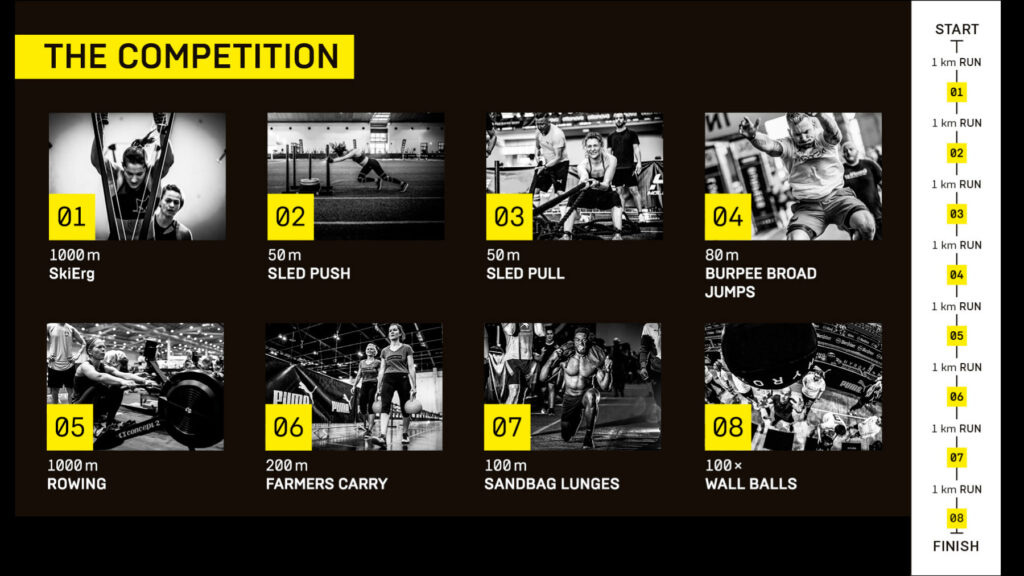
Fun fact: the name is a portmanteau (when you combine two words together, like in ‘brunch’ for example) of hyrbid rockstar.
Why is Hyrox so Popular?
There are a myriad of sociocultural factors that have lead to the popularity and ‘explosion’ of Hyrox. I claim no significant level of sociocultural expertise, though gym and fitness culture is something I have been part of for over 2 decades and as a runner I have seen the current running boom from inside (the relevance of these will become apparent).
Here are some factors that I think have played a role in Hyrox’s popularity:
The Running Boom - Hyrox is fundamentally a running based sport (more on this later) and so the running boom is certainly helping drive Hyrox’s popularity.
Simplicity and Accessibility - preparing and training for a Hyrox is not particularly complex (at least until you get to a high level) and most gyms will have the equipment required (this is by design). This accessibility etc includes the event facilities and organisation - which are much simpler and cheaper than involving road closures for example.
Brand Affiliations - Hyrox have done a good job of building brand partnerships that are well aligned. This stuff matters, a cool brand (you don’t have to agree) is essential nowadays.
Fitness Culture - it may seem silly to say, but broadly fitness culture has changed and now more ‘hybrid’ goals are in vogue. Hyrox allows success (and goals) for people pursuing this sort of training at least more so than many alternatives.
How Realistic is Hyrox Entering Olympics?
Usually this relates to chances of home country medals and given that Hyrox are targeting the Brisbane Olympics it’s worth considering this. As of the 2025 World Championships (season ‘24/’25), Australia had 5 athletes in the elite 15 (the top 15 in the sport) across the men’s and women’s divisions - for the record the UK had 5 and USA 9.
Despite the above, it is worth noting, that this is a very much fluid thing. It’s also worth considering the timeline to the Brisbane games (the median ages in the elite 15 are 32 and 30 for the current men and women respectively), likelihood of influx of athletes if it is announced as an Olympic sport and relative infancy of the sport in general.
Beyond these factors, facility-wise Hyrox is both easy to put on and good for both spectators in person and on TV. It also lends itself to a relatively simple system for medals (there are also doubles formats if more events are desired). When we consider some of the backlash to more recent exhibition sports (and sports added more formally to the Olympics) it will also probably see less backlash and perhaps aligns more with what people think about more traditionally when they think of the Olympics (no judgement here but for many, sports like breakdancing and even rock climbing aren’t what come to mind with the Olympics).
How ‘Fit’ Are Hyrox Athletes?
‘Fitness’ is always context specific, so in one sense we could say these athletes are some of the fittest in the world (in that they’re at the top of their sport). That said, it’s also worth noting that generalists (and most sports are more general than they are specialist - specialist sports are things like 100m sprinting, Olympic Weightlifting, Marathon running etc which are relatively narrow in their biomotor abilities required for success) will never achieve truly world class levels of any one biomotor ability because they have to balance many. If we look at Hyrox and the elite 15’s performance numbers we can start to appreciate which domains of fitness these athletes are performing better in though, using comparisons to other athletes (either specialists or other generalist sports).
Thankfully, this article gives good insight into both performance numbers, anthropometry and training characteristics of the elite 15. When examining it, some things quickly become clear (at least to someone who looks at sports and physiology as I do).
Running Performances; when looking at the running performances in the context of runners, these athletes look like very good enthusiasts - slightly better in shorter distances (like 5K) and slightly worse in longer stuff (like the marathon). This is probably a bidirectional relationship; their initial propensities combined with their training has created this picture of their running.
Strength Performances; when examining the group averages it’s pretty quickly apparent that these are of a much lower standard than the running performances (though there are outliers). Interestingly, this again looks like training has shaped it in part, as military press numbers look relatively better than bench press numbers.
Anthropometry; the elite 15 are heavier and probably a touch taller than elite runners, which makes some sense when consider height is more of an advantage on some of the stations and the muscle mass is necessary for them also.
*Caveat: Hyrox is still in its infancy and this data is easily swayed by outliers. The data will look different in a hand full of years I would suggest.
Hyrox Training
The above-linked article breaks down the training of the elite 15 at a high level and shows the variance in their training, which is probably more than many people would anticipate there to be.
What Can We Learn from the Training of the Elite 15?
The significant differences in the training of the elites probably reflect the what would happen at the population if training for peak performance level, to a degree at least. That is, when aiming for peak performance, you need to consider the requirements of the sport as well as the abilities of the individual, and work to optimise the two in that context. Generally this boils down to a needs analysis (aka gap analysis) as discussed in this piece.
Where you land when you do this needs analysis is distinct clusters of athletes;
Runners coming to Hyrox (I’d include trailrunners and obstacle course racers here).
Strength athletes coming to Hyrox (I’d include Crossfitters and many gym-goers here).
More rounded athletes (Some gym-goers who run a bit would end up here as would team sport athletes mostly).
These different clusters reflect different starting points with respect to running and the stations (and strength) and thus different relative strengths and weaknesses.
As a result their training would look different, especially earlier in their Hyrox careers and earlier on in a season. Early on (both season and career again) there would be a good amount of time devoted to weak points. This then progresses to a more event requirement based training during the later phases of the training cycle. So earlier on, we address weak points (individual dictated) and progress to addressing event requirements (event dictated). This pattern is the same in almost all physical preparation for sports. As a result the discrepancies in running volumes seen in the elite 15 probably make sense (despite it being a running sport) - remember everyone has resource limitations of some sort though I do think there is some meat left on the training volume bone for the Hyrox elite 15 (it may be that their volume grows over time - remember, young sport).
It is worth noting that as mentioned before, Hyrox is a running sport. The running is >50% of the event for most people, including the elites (where it can be closer to 60%). So there’s no escaping needing to be able to run well. As a result runners are performing well because running ability is being rewarded. This is also why there is a large emphasis on running in the training of the elites, even if they have a running background.
What Does Hyrox Need to Do to Sustain it’s Momentum?
One challenge for Hyrox from a mass participation standpoint and to a degree as an elite competition (and if it has spectator sport aspirations - which all sports do) is part of its initial appeal - simplicity. Hyrox, outside of the weights (which are scaled by gender and performance level) and maybe some friction differences for sled surfaces (a recent point of contention), Hyrox is the same everywhere and anywhere. It doesn’t change. Given this and its relatively simple nature, performances have reached an asymptote or plateau quite quickly. Whilst I am sure times will continue to improve, margins are small in competitions and times will only improve by seconds in the foreseeable future.
This is in contrast to Crossfit (which some may call a predecessor), which was almost chaotic in its ‘it can be anything and everything’ nature. It is also in contrast to a more contemporary, competitor of sorts, ATHX - which has a consistent structure and expectations (and even competition within a year) but then varies specifics year to year.
The Solution
Part of this depends on Hyrox as an organisation, their values and how they want to evolve (or not, after all many people do the same marathon year after year or similar). Everything I have heard from them suggests they will not change their product at all, I applaud wanting to stay with their original vision but I have also seen this from other companies who have eventually had to pivot in part (including an entire brand being built on being without flavour which is releasing flavours). I want to be clear - I think this is a potential issue BUT I also think clarity of vision is important and being true to the ethos of a company is generally a good thing.
Again, the degree of change is on the organisation, but if we work on the thinking of minimal viable change then the following are some potential creases that could be introduced to create some variety.
Change the station order - this could either be consistent OR dictated by order. Eg first back from the run chooses their station and so on, which introduces a more tactical pacing aspect to the running.
Change the run distances (rather than 8x1km, use the 8km total and mix it up eg 4x1.5k & 4x500m).
Scale the stations by a percentage eg increase weight by 10% on some and reduce by the same on others.
There are many more ways Hyrox could evolve, but the above represents the minimal viable changes that could create enough difference to create interest, challenge and perhaps different performances at the elite end (at least in my opinion). There is always the option for Hyrox as an organisation to decide that it will change more significantly, as well as the option to just up the resistance or change the distance on all implements.
Where Would You Go Looking for The Olympic Medalists in Hyrox?
Given that the Brisbane Olympics are in 2032, you’d want the athletes in their peak at that stage. The nature of Hyrox is that it is a running based, endurance sport so the likelihood is these athletes will be mid 20s to early 30s - more importantly placing them at somewhere in their late teens to early 20s currently.
Looking at the sporting backgrounds of the current elite 15 can give some insights into where the next generation of these athletes may come from, as can the constraints of the sport itself. In the former, there’s a great propensity for running and running based sports as well as triathlon - which is probably no surprise.
In the latter, it would be fair to characterise Hyrox as a running based endurance sport in the 50-60min time domain, which suggests it would align well with half marathon performance. Adding some nuance, to this broad overview would suggest that unlike half marathon runners, who may be succeeding based on aspects of durability, and efficiency, the full body and more hybrid nature of the event may be better suited to athletes with a higher VO2Max. Given this, and the fact that height is a net advantage by the look of both the current elite 15 and the mix of running and stations; outside of cross country, track & field and triathlon, sports such as Australia Rules Football (AFL) or Gaelic football and rowing come to mind as high potential for talent transfer targets or indeed key development sports.
For more on aspects of endurance like VO2Max and durability and how they factor into performance this podcast episode will help (from 23:40 onwards).
Like it or not, Hyrox is here to stay (at least for the foreseeable future). I’d wager it’s also a fair chance at an Olympic berth in 2032 too - so it’s worth getting used to it I’d say!
For another perspective on Hyrox I also enjoyed this piece from Allison Lynch (marketing director, North American Sports for Amazfit) about her experience at a Hyrox event.
Things I’d also love to consider evolving
— wall balls shouldn’t have a depth “outcome”, they should be ball to the target (an athletes strategy depends on their tactics; if they want to squat deeper, only use their arms, “push press”)
— I’d love to see a pull-up variation in a station, instead of something (maybe the sled pull). This IMO would be way more representative of upper body strength, and would very quickly separate out elites
— the burpee broad jumps are too rule heavy, and would love to see them just shift to a standardised burpee (touch the bar overhead, hand-release at the bottom)
— like the idea you have on varying running distances, I’d love to see 400/1000/1600/5000
Like it or not - I don’t. But that’s just personal opinion. Are there really major efforts underway to make Hyrox an Olympic sport? That completely passed me by... I'm not convinced either. Compared to most sports, Hyrox is still so young. Shouldn't it prove itself and mature first, in a sense?