
Stryd
Use of running power and advanced gait kinematics in health & performance


Regular readers would know I recently welcomed Stryd as a sponsor, and as a result I have had some questions and feedback; the result being me needing to write an article about my use of Stryd. Of course, as with the initial announcement, it is important to be clear - this is not something the company have asked for, nor are they aware I am writing it before delivery to their inboxes like the rest of you.
For those not familiar, Stryd make running power meters which are small pods that clip onto your shoe laces and transfer between shoes. They link to sports watches providing real time data and a host of post run data in app. The company also has it’s own dashboard (the “PowerCenter”), which we will touch on later as I think it is HEAVILY underused by most. The sensors obviously provide running power data (we will get into what this means), as well as gait kinematic and kinetic data.
Performance
There are many ways different people may use Stryd when it comes to performance, including some ways that I don’t use myself, which I will touch on more briefly.
One of the initial value propositions of Stryd was ‘running power’ with the corollary being a power meter in cycling. In a good case of ‘a little knowledge is dangerous’ (aka the Dunning-Kruger effect) I was of the belief this was not possible. To be fair, my thought was that the output was meant to correlate with net mechanical power (as cycling power meters provide) which is not the case, Stryd actually provides net metabolic power. To simplify this, I thought Stryd’s power provided an external workload measure (how much power is being put into the ground) when in actual fact it provides an internal workload measure (what it costs you to run the current speed).
In essence this can be used to help folks ensure their intensity is appropriate including to pace races, particularly in more adverse weather conditions and/or on hillier terrain (for the record, the PC based dashboard aka “Stryd PowerCenter” has a feature that can help build race plans based on courses and weather which I think is underutilised by many).
As I mentioned in a comment to Mario Fraioli recently, my take here is that this is best used for feedback to improve independence NOT create dependance on technology.
Another way that many folks use Stryd is to understand shoe efficiency (and thus chose the best shoes for race day). I’ve certainly done some of this testing, as you can see in the below reel. I do know a few running speciality stores are trying to launch something similar to this but I am not convinced that it would be that helpful - part of the value of Stryd and the challenge of “supershoes” is that we need to have insight into, not just fresh state performance, but fatigued state performance also (ie what is this marathon shoe looking like at 32km/20mi not at in the first 5k/3.2mi).
Functional threshold power aka FTP is a cycling metric around which much training is planned. It represents the best average power able to be produced for an hour. It is worth nothing that this power is a net mechanical power, with the more mechanically minded readers probably appreciating that in running we do not have an equivalent per se. We have two corollaries though; critical pace (the sustainable average pace for an hour) and critical power (through using Stryd and thus reflecting net metabolic power). Interestingly, there’s been some research using Stryd and trying to correlate its metrics with established physiological anchors (which makes tonnes of sense given these are usually lab derived and a cheaper, easier and less invasive method to obtain these would be helpful to say the least). Critical power from Stryd looks to both match critical power modelling (you’d assume this as it’s what they would have built the model on) and moreover, correlates well with second metabolic threshold. Again, this makes good sense when considering that this may be more or less correlated based on certain training characteristics (whereby this threshold as measured by lactate or gas exchange may move with respect to best 60min effort).
Why Would Someone Train With Power?
This is a particularly good question, because without it the assumption is that it’s a preference thing. There’s certainly an aspect of preference to it, but other reasons include the fact that it’s effectively a measure of internal load, not dissimilar in some ways to lactate. Heart rate is another example of an internal load measure, which is a little more labile (which I do believe is signal for the most part rather than noise) but the addition of an additional measure can be helpful in this sense, for example heart rate will be higher in the heat. Using internal load measures (rather than external load measures such as pace/speed) can help ensure intensity is correct (improving training plan execution), particularly in variable conditions (think weather, hills or treadmill).
Generally, training to internal load measures is of more importance the further away from competition someone is. In contrast, closer to race day and having gained insight into what’s possible from previous training, I tend to suggest being more focussed on external metrics (as this is what races are decided by - of course, it is never either/or but more of an emphasis of one over the other).
The third factor in this, that should NEVER be forgotten is perception/feel, something we should be dialling in, using feedback from all sources, at all times.
Remember - it’s data informed, not data dependant.
Thanks to Stryd for their support of this newsletter. I have been using their running power meters for years and I’ve found the data to be very insightful from a mechanical loading perspective as I covered here in both health and performance contexts.
Please do follow the link to help support both them and this work.

Health
As I seem to write regularly, health and performance are not always aligned as I covered here. In this case, they mostly are though - that is, without a healthy body performance (in a running sense) is out the window. Zooming out a level, this also has broader health implications to a degree in that limiting running may limit exercise (it shouldn’t, but we are all human and runners like to run) and certainly could impact mental health. This too, could have knock on effects to performance outside of the running space which runners would attest to - it’s hard to show up as your best if dealing with an injury at times (I am getting WAYYYY better at this but the point remains).
Injury Risk
One of the most intriguing parts of Stryd’s offering is the gait kinematic and kinetic data they have and can provide. Some of this is not unique to Stryd, with other companies and devices providing some basics such as left/right balance (effectively this is a symmetry measurement between sides). The more unique portion of the offering is when using the Stryd Duo (2 pods, 1 per shoe) where you start to see differences with greater granularity, how they change across a run and trend over time.
Should we really be Symmetrical?
The short answer is probably not, there are many reasons that asymmetries may exist (I covered the fact the body is a solution creator and robust here) and they’re not always something to solve. That said, if they’re significant (an arbitrary threshold of 10% is often used) then some work to try even them up may be worthwhile.
Regardless of whether we start off symmetrical, we should ideally not deteriorate significantly from our starting point. That is, starting off with a 1% difference, ideally should not end up with a 10% difference at the end of the run. The causes of a deterioration like this are well beyond this article, but include things like compensations, strength deficits and perhaps pain.
I want to be clear that overuse type injuries occur when tissue capacity is exceeded and the body can adapt to many things (see Prisca Jeptoo). So whilst the above is helpful with respect to limiting potential injury risk, not addressing the above is no guarantee of an injury. That said, there’s also no real advantage to leaving it unaddressed aside from not having to change anything you’re doing.
As an aside, I am hoping Stryd release a level 3 type feature which flags, potentially live or if not at least in-app post run, any significant changes/deteriorations (perhaps with adjustable thresholds) for users to help with decision making and injury risk.
Rehabilitation
I’ve been diligently rehab’ing an annoying achilles issue for a good portion of time, having previously just managed it rather than taking the time to step back and rehab it properly (the cobbler’s children never have shoes and all that). But this isn’t a sob story, it’s about the insights I’ve gleaned from Stryd in the process - which I find to be valuable.
Of course, key outcomes for me are pain reduction and capacity improvement, the latter of which is hard to quantify in a vacuum. Traditionally we would load a tendon, and see how it responds but as I have noted before, load is quite hard to quantify. In this case though, I have some objective data about load and load tolerance.
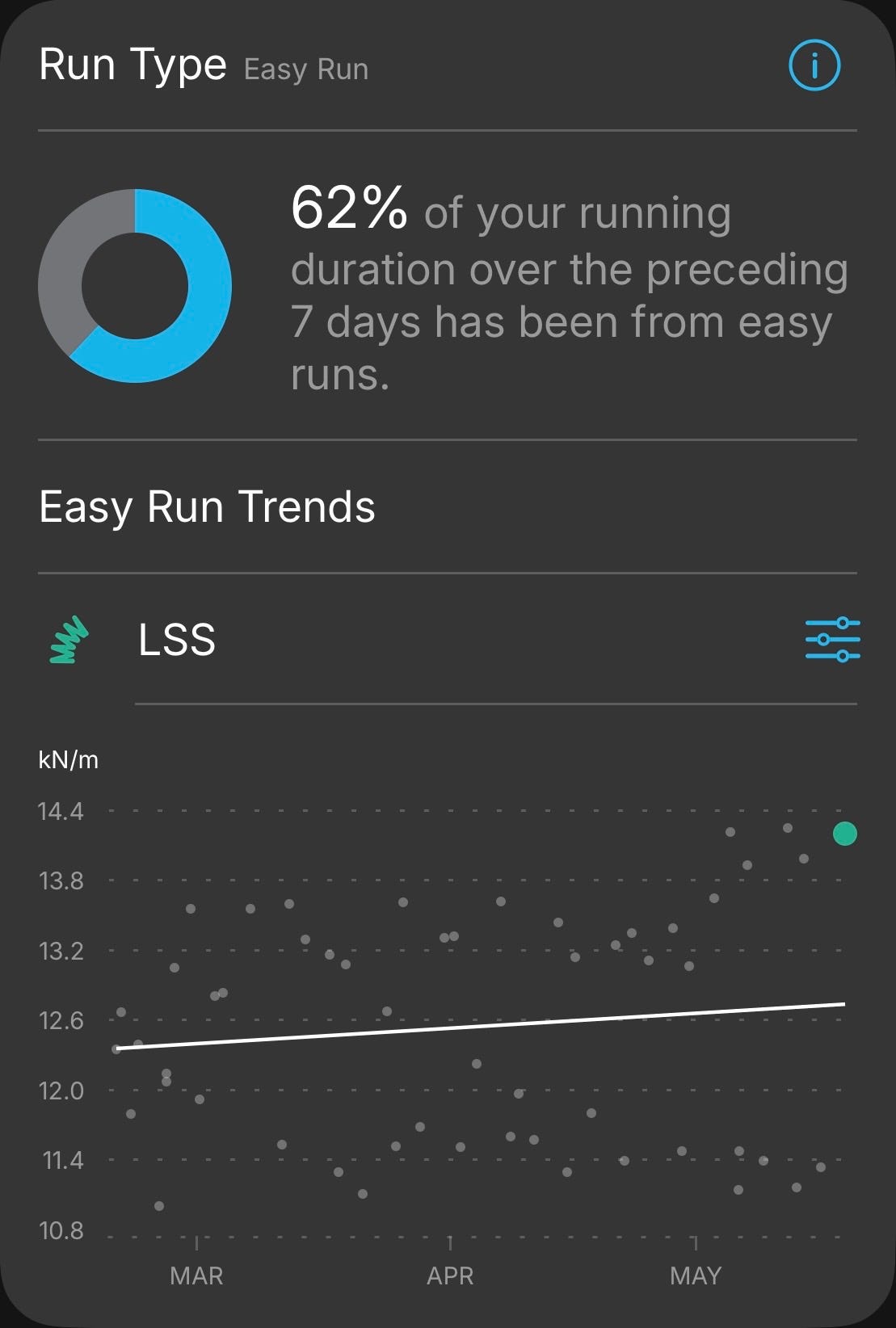
Below you can see an indication that over the past 3 months, my ‘leg spring stiffness’ (it’s a little technical but it’s broadly as it sounds) which is a good indication my achilles’ capacity and load tolerance are improving (my leg is behaving more like a spring, which is the role of tendons). Particularly in the context of simultaneously improving pain and day to day function.
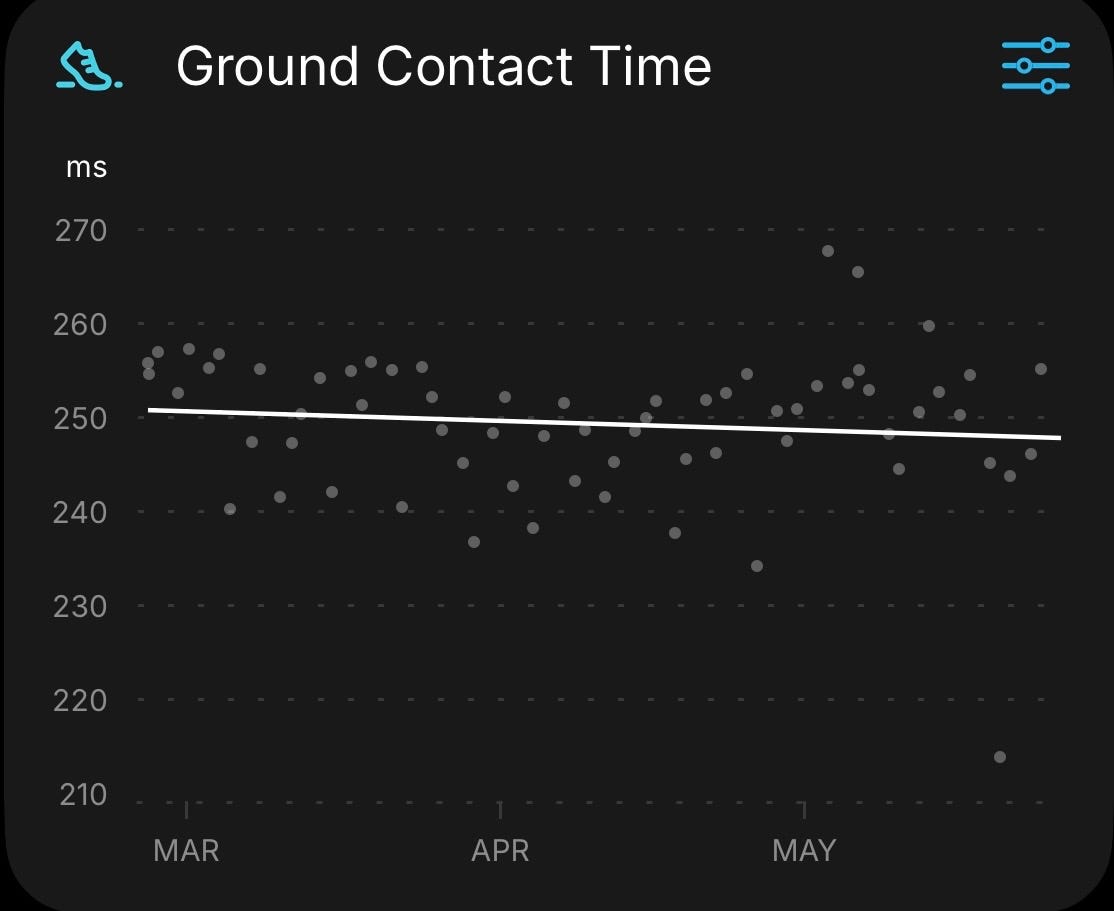
Bolstering this observation is my ground contact time (GCT) over a similar period (on the same runs). GCT is as it sounds; the amount of time your foot is on the ground. This is heavily speed and shoe dependant (remember, these runs are same shoes, surface and speed). As would be expected with a more spring-like running (and tendon capacity improvement) my GCT has gone down (and likely flight time has gone up - this would be somewhat cadence and stride length dependant but this isn’t a biomechanics lesson).
To give a higher level overview, the below graph shows Lower Body Stress Score (LBSS) which is, in effect, the mechanical load my legs are experiencing (in this case daily). Of note the peaks are high (long runs are progressing) and there’s a small upward trend (remembering I am progressing in the gym too which is not captured here so I need to be careful not to overdo things by increasing both too much). Again this is a good indication that the tendon’s capacity to tolerate load is improving using a broader frame of reference (rather than a trends from single runs).
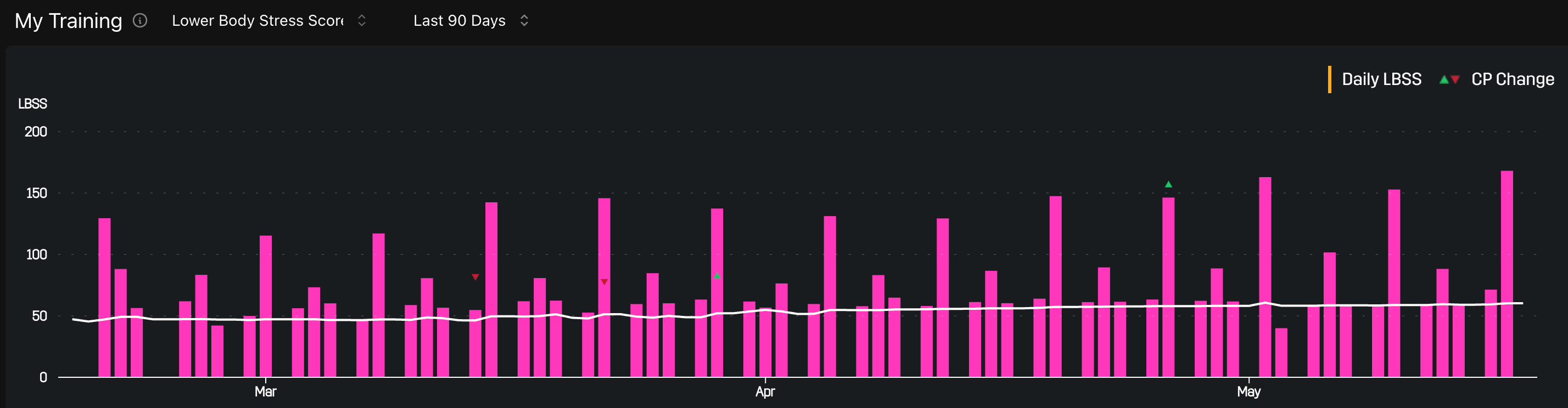
This is also important because there’s always a risk for a new injury on the return from injury if other tissues have lost capacity. It’s a fairly common pattern to see folks have a run (pun intended) of injuries in a row at times.
I want to reiterate this article is a result of questions and a suggestion from a fellow author to explain my use of Stryd. It’s not a paid piece, but my work is supported by Stryd (a decision I made as a result of my use - not the other way around). As always, questions and comments are welcomed either on Substack or via replying to the email you received.
Aside from liking this article and sharing it with others, not to mention subscribing to the newsletter, you can support my work by following the link above to visit the Stryd website, which of course supports them and lets them know you’ve come from here.
References
Adejuwon, D. C., Faricier, R., & Keir, D. A. (2026). Running Power at Lactate Threshold and Lactate Turnpoint Are Unaltered by Treadmill Incline. International Journal of Sports Physiology and Performance (published online ahead of print 2026). Retrieved May 15, 2026, from https://doi.org/10.1123/ijspp.2025-0579
Jaén-Carrillo D, Ruiz-Alias SA, Olaya-Cuartero J, García-Pinillos F. Stryd biomechanical parameters as indicators of running economy and performance. Proceedings of the Institution of Mechanical Engineers, Part P: Journal of Sports Engineering and Technology. 2026;240(1):141-149. doi:10.1177/17543371231220760
Hudgins JH, Pastina JT, Gillis IL, Abel MG, Bergstrom HC, Black WS, Best SA. The Ability of Stryd Footpod Metrics to Reflect Changes in Metabolic Power Between Running Shoe Types. J Sports Sci. 2024 Dec;42(23):2229-2241. doi: 10.1080/02640414.2024.2426903. Epub 2024 Nov 20. Erratum in: J Sports Sci. 2024 Dec;42(24):2582. doi: 10.1080/02640414.2024.2440240. PMID: 39565291.
Koegel, J.; Huerta, S.; Gambietz, M.; Ullrich, M.; Heyde, C.; Dorschky, E.; Eskofier, B. Clustering Runners’ Response to Different Midsole Stack Heights: A Field Study. Sensors 2024, 24, 4694. https://doi.org/10.3390/s24144694
Dearing CG, Paton CD. Is Stryd critical power a meaningful parameter for runners? Biol Sport. 2023 Jul;40(3):657-664. doi: 10.5114/biolsport.2023.118025. Epub 2022 Sep 15. PMID: 37398957; PMCID: PMC10286607.