
Building the Perfect Athlete
Lessons for health and performance from a thought problem


In the world of coaching it is well accepted that constraints drive creativity, giving rise to the ‘constraints led approach’ (CLA). In very brief, the CLA involves imposing constraints (think rules, implements, playing area size etc) to create problems to solve, thus driving skill development in addition to game sense etc. The world of creativity too, is starting to better appreciate the value of constraints, so much so that one of my favourite authors David Epstein has recently released a book on it (which I greatly enjoyed). It’s this approach that has generated a thought problem I have spent an extraordinary amount of time thinking about over the last 20 years;
“how would you build the perfect athlete if that was your goal with a child?”
This is, of course, a bit of absurd situation to consider and trying to achieve this outcome is almost paradoxically the only way to ensure it doesn’t happen (teenage rebellion anyone?). But the goal isn’t to build a program that is followed; it’s to use the thought problem to understand the principles which would underpin the approach and then apply them appropriately. It’s this learning, the result of the thought problem, that has served me well in multiple roles I’ve held over the years (for example as the technical director of a rugby academy).
Whilst this piece focusses heavily on athletic development, and thus performance in the sporting realm, it has significant relevance via both resulting principles and lessons that can be applied across other fields of performance as well as in health. Not to mention the very meta concept of the thought problem that could well be taken across to these areas.
What’s the Goal?
One challenge often encountered in athletic development (and to be fair, many performance environments) is a lack of clarity around the goal (or the real goal). Specifically, folks often have a disconnect between what marketers would call ‘stated preference’ and ‘revealed preference’ (ie what they say is the goal and what their behaviour indicates is the goal when pressed). Generally, folks will say they want happy children and/or children or parents will say they want success in sport at the professional level ie as adults. Rarely are the choices made aligned to this though.
A happy, healthy adult is completely different to an elite athlete, though they may have followed similar paths for a period of time (see below discussion of long term athlete development to see timings). Similarly, success timeline is crucial to understand, as decision making is influenced by it and significantly so. The best way to be considered the best 14 year old prospect in the country (aside from being born in January) is by specialising very early and hyper-focussing on the sport of interest, to the detriment of relationships, schooling etc. This isn’t the same strategy one would use to be the best college/university athlete, or indeed best professional (let alone healthy and happy adult). These decisions aren’t always easy to make but just like in business (amongst other fields) clarity of goals, values and mission means decision making during tough times is made simpler (if not actually easier).
Constraints Led Approach
At high level, the CLA is about manipulating constraints to drive learning (initially motor/skill learning but I’d argue there are cognitive aspects to it also). Constraints are generally divided into three categories for manipulation:
Environment
Task
Person
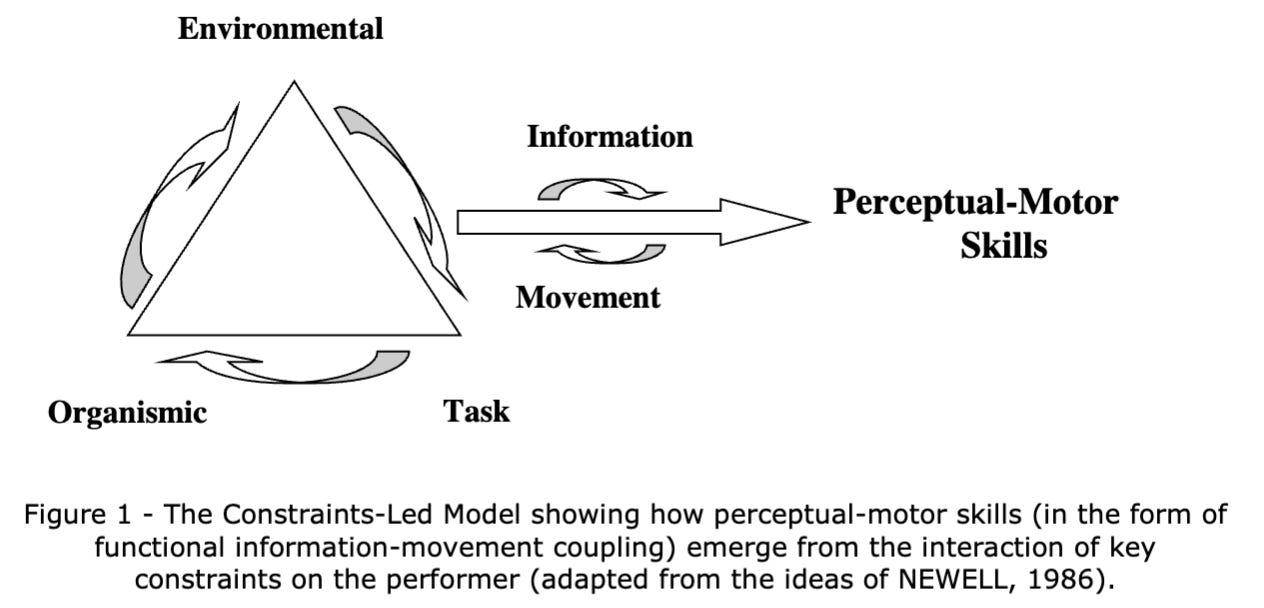
This approach is classically used to help design sports coaching sessions and I won’t get too technical here, but at a high level if we take the above and apply it outside of any one sport we start to see the benefits of a multisport approach. A variety of different sports creates a variety of different environments and tasks and as such individuals develop more broadly and wholistically. The most crucial factor is that some of this learning transfers ie a solution from one sport may be used in another. This may be why Nikola Jokic is such a good basketball passer; his childhood of informal waterpolo playing. For more on this, and the ‘athletic skills model’ which covers many of these concepts, this article is great.
Specialisation
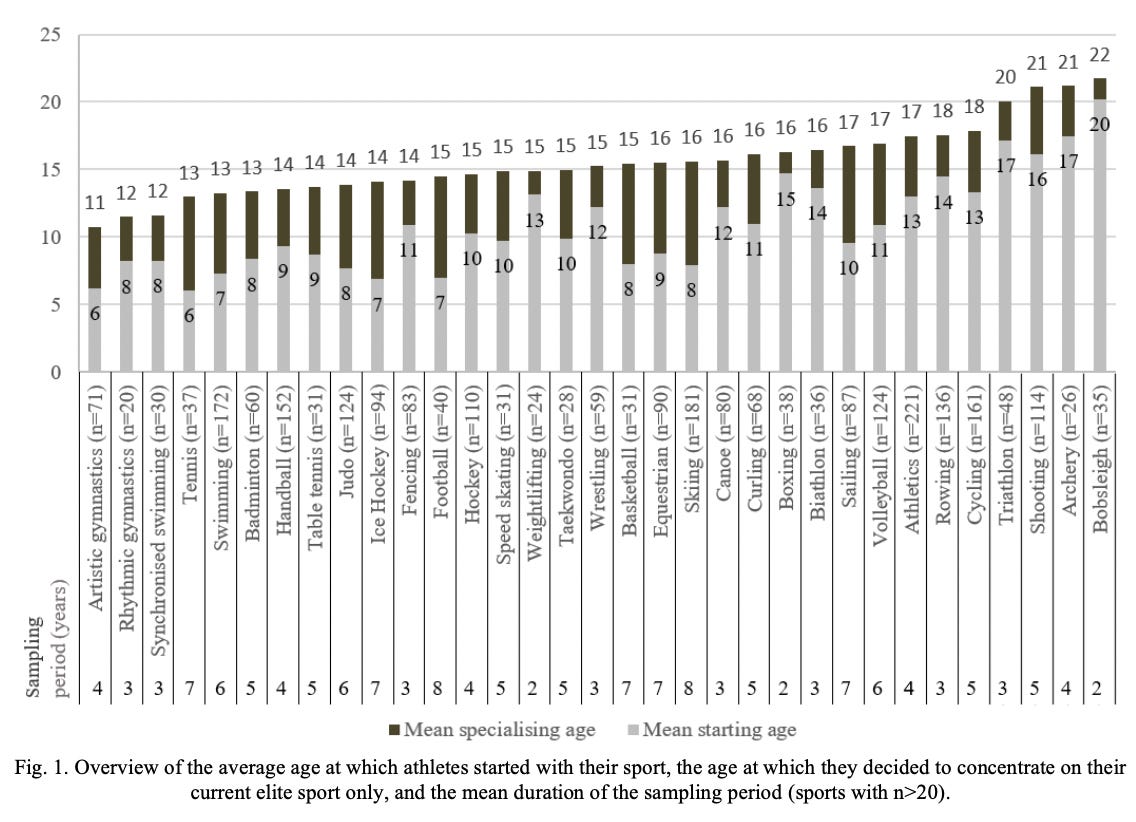
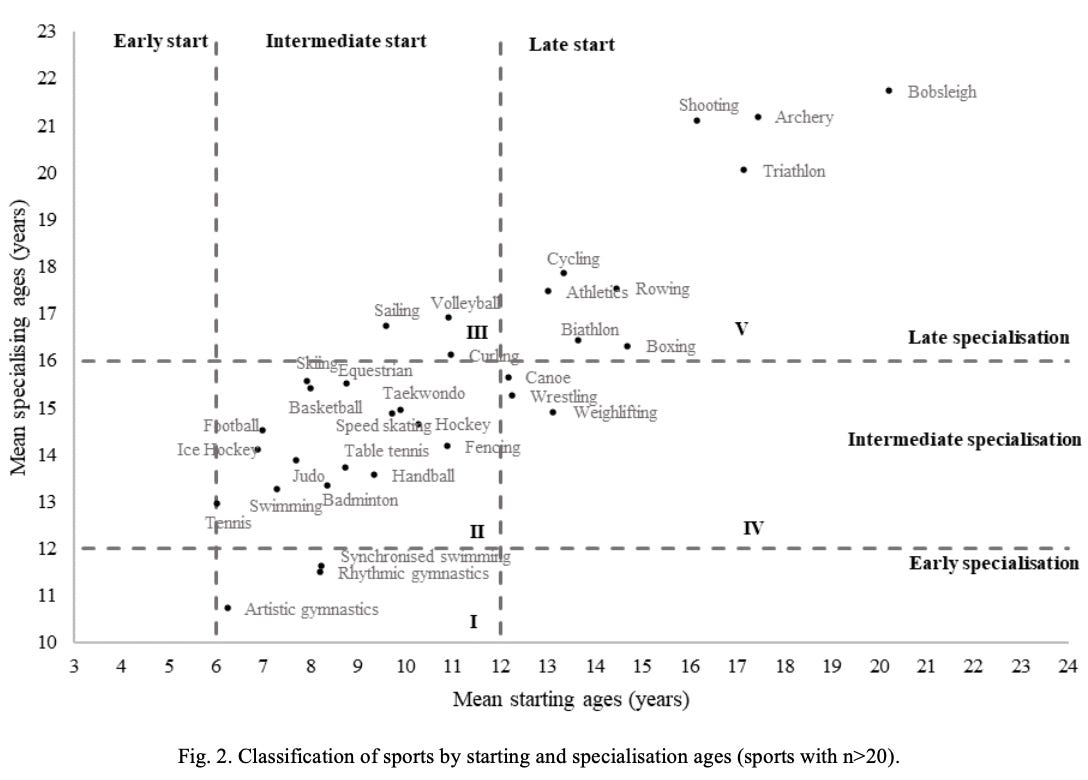
There is lots of discussion around early specialisation in sport. The TLDR is that early specialisation tends to track with worse outcomes (think injury risk, and success in sport as an adult). There are, of course, exceptions - certain sports are early specialisation sports like gymnastics, and then of course certain athletes (let’s remember they could be successful despite this not because of it). By chance, the aforementioned David Epstein wrote a book about this topic in a broader sense (not just sport, but other performance areas too) called Range which I’d highly recommend.
The prevailing point is that having a variety of experiences, aids in solving problems (be they movement or other) due to having had exposure to different constraints and challenges, some of which are more directly applicable than others. The variety of exposure generally means a variety of movement(s) also, and as such limits excessive exposure to repetitive movements and limits injury risk (short and longer term).
In a great paper, which looked at Olympic sport athletes, from 13 countries with 2,838 athlete responses (43% female) to the researchers’ survey some great insights were revealed. Of specific interest in this case are the two figures below.
Long Term Athlete Development
Sometimes bundled into later sport specialisation is the concept of “Long Term Athlete Development” (LTAD). In essence, the concept and framework was born out of childhood (and adolescent) development, on all fronts; mental, physical, emotional and psychological. One of the seminal figures in the space is below and explains (perhaps a little more technically than needed for most readers) this well.
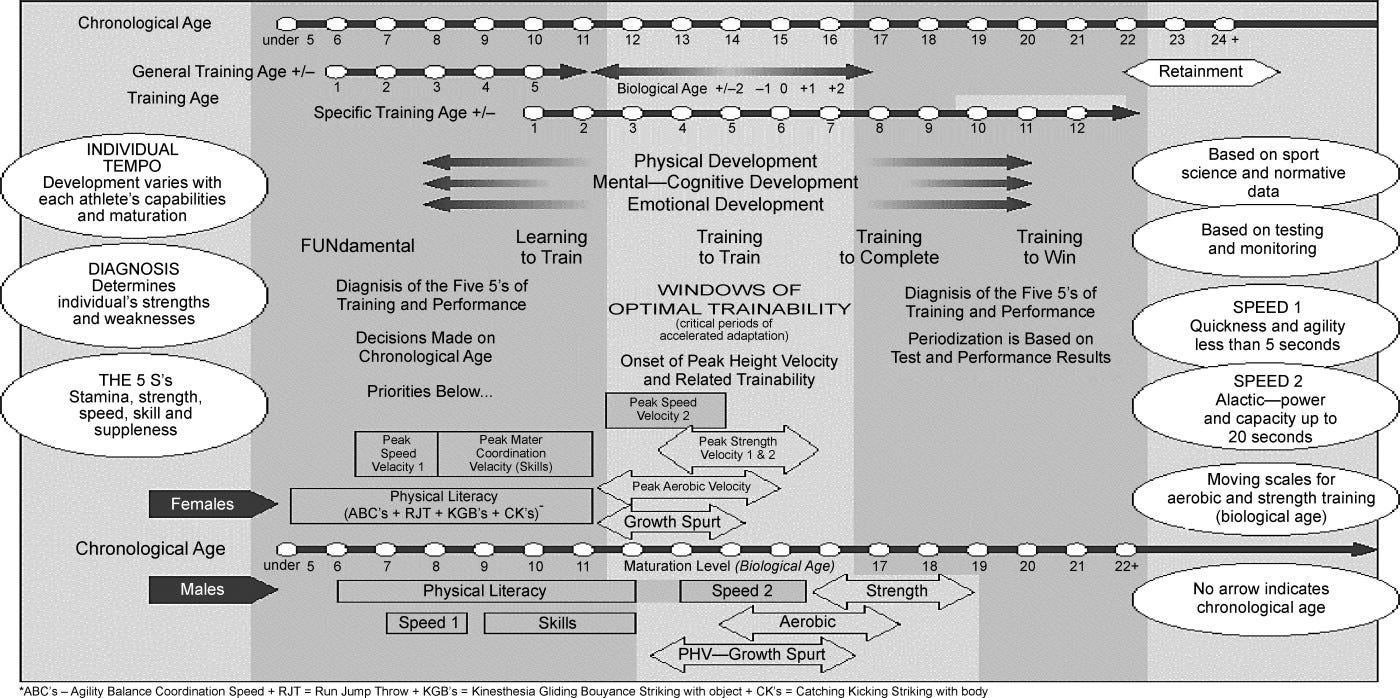
Of note, there is advice for ages of commencement of general training as well as specific (top 3 lines) whereby training age (as distinct from chronological age) is the number of years the person has participated in the sport/trained for it. The key concept/phases of the LTAD model are also covered below the development arrows, specifically (in order); “FUNdamental, Learning to train, Training to train, Training to compete and Training to win”.
A really nicely developed graphic visualising these phases, as well as contextualising them in the lifetime and life is below from Human Kinetics.
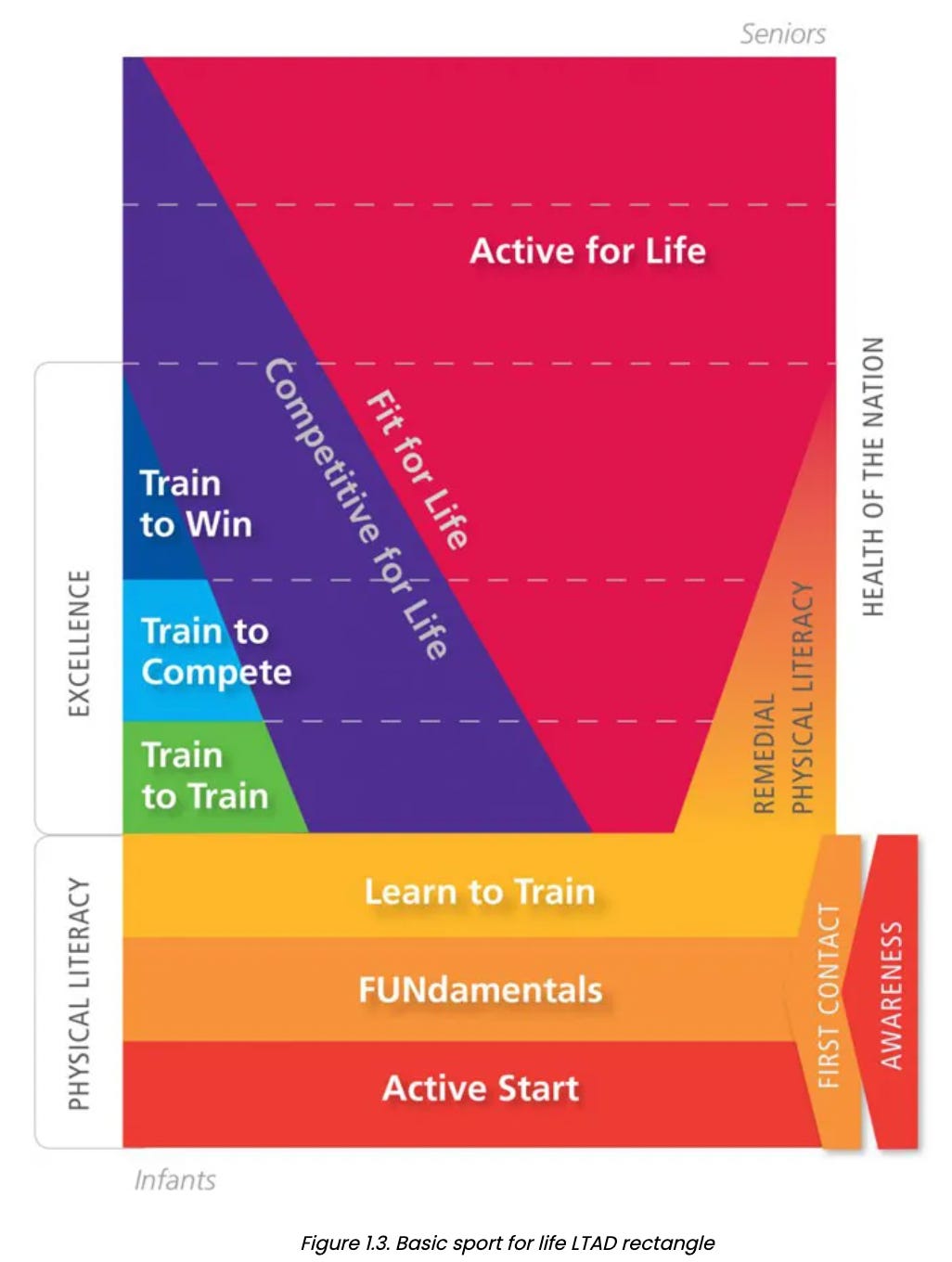
Of note, the active start prior to any sporting involvement as well as the two sides to the phases following “learn to train” phase where folks may not progress and may just (hopefully) stay active. I cover this more below.
Norway’s recent successes on the world stage are truly remarkable for a country of it’s size, especially in the non-winter sports. The result of this is many folks trying to understand why they’re so successful, with many articles, podcasts etc about it. Part of Norway’s success is driven by their approach to sport, competition and ages which effectively boils down to LTAD at a high level. Another is the number of qualified coaches and these coaches adherence to national standards around things like terminology.
Play
Many of the older readers in the readership will remember being told to “go play outside” with almost no more instruction than that (and perhaps a time to be home). The resulting situation often amounted to making up activities or games, with whatever was available, sometimes yielding games that persisted as staples. All of this, developing creativity (on many levels) as well as skill. There are innumerable stories of backyard cricket where constraints were imposed to avoid windows, or similar - which is basically the CLA in action. Unfortunately, the prevalence of this in society is plummeting for a myriad of reasons. To underscore the importance of unstructured play as mentioned above; one of the other rugby academies in the system I was involved in were working on ways to introduce unstructured play to the time they had with the players! In effect, the academy had realised that players aged 13-18 were having the height of their pyramid’s limited by the breadth of the base (see below), and as such instead of specific skill development they were trying to drive informal skill development (the paradox isn’t lost on me)!
Thanks to Stryd for their support of this newsletter. I have been using their running power meters for years check out this article for more on the use of Stryd for both health and performance.
Please do follow the link to help support both them and this work.

So What Would the Ultimate Plan Look Like?
The basis of all sporting performance, and health, is significant amounts of physical activity, specifically unstructured physical activity. This includes general movement (ie minimising sedentary time) as well as unstructured play (see above).
When considering athletic development, generally the pyramid shape is invoked. This is often with relevance to development of an athlete; whereby a broad base of capacities, abilities and movement proficiency allows a taller peak of performance. But it is also the shape invoked with respect to numbers of athletes involved at various levels of performance (more recreational at the base) to have a successful few athletes graduate out of the development system (whatever it is) - this is another key portion of the aforementioned Norwegian approach; keeping children engaged for as long as possible. Back to the individual; building a broad base on which we can layer more specific abilities as time passes and the child shows propensities for certain activities is key. This generally requires a variety of movements, with exposure to key movements and abilities and as such I’d suggest starting (early childhood) with the foundational sports of: gymnastics, swimming, track & field and Australian rules football.
Gymnastics - Perfect for general kinaesthetic awareness, basic movement patterns, strength and coordination.
Swimming - A fundamental skill for some sports, good for aerobic and anaerobic conditioning as well as important for safety and health.
Track & Field - Many fundamental movements are covered (run, jump & throw), good for coordination and excellent for speed and power development.
Australian Rules Football (video here)- Excellent for hand-eye and foot-eye coordination, vision developed in 360 degrees, basics of contact & collision sport covered and a good amount of running and jumping. Other options could be basketball or football (soccer) but Australian Rules almost encompasses both already hence my preference.
Not mentioned or featured in the above list, is tennis. There’s certainly an argument that it could and/or should be included, at least partially because its an early specialisation sport (for the record, so are gymnastics and swimming). There’s also an argument that olympic weightlifting could be included, partially because of its value in physical development (strength and power) but it could also be commenced later on.
Following the childhood years, and transitioning into the pre-teen years, it may be worthwhile to consider removing the gymnastics unless there’s significant prowess (and short stature) shown - it’s at this stage it transitions from fundamental sport into heavily specialised and goes from a general to specific sport. It could be replaced by Olympic weightlifting, or general strength and conditioning or even another sport. Similarly, swimming becomes more serious, to a point where switching it for another sport if prowess and enjoyment isn’t there makes sense too (though one could continue less formally).
Repeated sampling of different sports through both phases would be a goal, this could include combat sports or similar also, again the goal through the early phases is to gain a broad experience, increasing the available movement library.
Slowly as the years progress, and preferences and propensities emerge, things can become more narrow. This timeline is intentionally vague for reasons covered already, specifics for certain sports and of course preference to some degree.
Health
Thinking about this through he lens of a high school athlete, graduating into college/university, and using a purely health perspective this person now has the ability to play any amount of recreational or social sports, has a competency with many training paradigms and is proficient in many more traditional ‘fitness’ settings (like the gym). They’re equipped with physical literacy that will serve them well for life.
They’ve also maintained a good level of activity through the formative years, developing the cardiovascular and musculoskeletal system well - setting them up for the best chance they can have at this age for good health and longevity.
Hopefully, the thought experiment I have been noodling on for the best part of two decades served as an enjoyable jumping off point for readers, whilst simultaneously inspiring you all to be active (and create a love for activity in your children if you have them - whilst also preventing premature sporting specialisation). Similarly, hopefully the undertone of the importance of constraints as drivers of creativity and problem solving was self-evident.
As always; if you have thoughts, feedback or opinions please do reply to this email or comment on Substack. Similarly, subscribing really does help, as does sharing the piece with others you think will enjoy it (or on social media).
References
Renshaw, I., & Chow, J. Y. (2019). A constraint-led approach to sport and physical education pedagogy. Physical Education and Sport Pedagogy, 24(2), 103–116. https://doi.org/10.1080/17408989.2018.1552676
Uehara, L., Button, C., & Davids, K. (2019). Sport expertise development and the constraints-led approach. Conexões.
Creating adaptive athletes: the athletic skills model for enhancing physical literacy as a foundation for expertise. Geert J.P. Savelsbergh and Rene Wormhoudt. Mov Sport Sci/Sci Mot, 102 (2018) 31-38. DOI: https://doi.org/10.1051/sm/2019004
Myer GD, Jayanthi N, Difiori JP, et al. Sport Specialization, Part I: Does Early Sports Specialization Increase Negative Outcomes and Reduce the Opportunity for Success in Young Athletes? Does Early Sports Specialization Increase Negative Outcomes and Reduce the Opportunity for Success in Young Athletes? Sports Health: A Multidisciplinary Approach. 2015;7(5):437-442. doi:10.1177/1941738115598747
Myer GD, Jayanthi N, DiFiori JP, Faigenbaum AD, Kiefer AW, Logerstedt D, Micheli LJ. Sports Specialization, Part II: Alternative Solutions to Early Sport Specialization in Youth Athletes. Sports Health. 2016 Jan-Feb;8(1):65-73. doi: 10.1177/1941738115614811. Epub 2015 Oct 30. PMID: 26517937; PMCID: PMC4702158.
Jayanthi N, Pinkham C, Dugas L, Patrick B, LaBella C. Sports Specialization in Young Athletes: Evidence-Based Recommendations: Evidence-Based Recommendations. Sports Health: A Multidisciplinary Approach. 2013;5(3):251-257. doi:10.1177/1941738112464626
DE BOSSCHER, Veerle, DESCHEEMAEKER, Kari and SHIBLI, Simon (2023). Starting and specialisation ages of elite athletes across olympic sports: An international cross-sectional study. European Journal of Sport Sciences, 3 (5), 9-19.
Ford P, De Ste Croix M, Lloyd R, Meyers R, Moosavi M, Oliver J, Till K, Williams C. The long-term athlete development model: physiological evidence and application. J Sports Sci. 2011 Feb;29(4):389-402. doi: 10.1080/02640414.2010.536849. PMID: 21259156.